
Most corporate blogs make a common mistake: they create "random acts of content." One day they write about a trend, the next a small tip, and the following week they analyze a completely different topic. The result is a collection of disconnected articles that confuses both Google and your readers. This approach might bring in sporadic traffic, but it will never help you build true authority or dominate the topics that matter most in your industry.
If you want to escape the cycle of directionless content creation and start building a valuable, long-term marketing asset, it's time to learn about the Topic Cluster model.
This isn't just an SEO tactic; it's a philosophy for organizing your content to become the most trusted resource in your field. In this article, we'll break down what the Topic Cluster model is, why it's incredibly effective, and provide a step-by-step guide on how you can implement it to build sustainable brand authority.
What is a Topic Cluster? Decoding the Power Structure
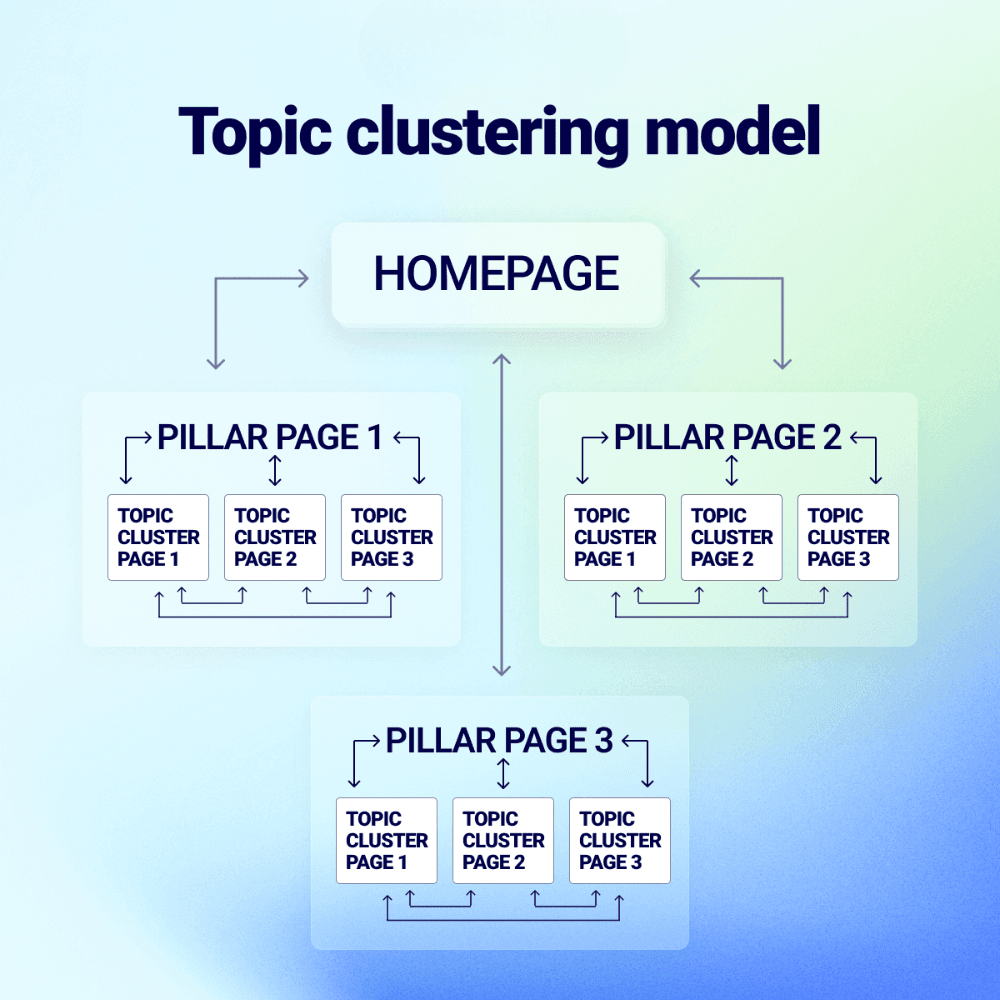
Imagine your content is organized like an in-depth book rather than a messy pile of magazines. That's the core idea behind the Topic Cluster model. This model consists of three main components:
- Pillar Page: This is the "main chapter" of your book. It's a long, comprehensive piece of content that covers a broad and competitive topic (e.g., "A Beginner's Guide to Digital Marketing"). This page doesn't go into extreme detail on every single aspect but serves as a central hub—an overview map of the entire subject.
- Cluster Content: These are the "sub-sections" within the chapter, designed to dive deep into specific facets of the main topic. They are shorter, more focused blog posts targeting detailed, long-tail keywords (e.g., "how to write effective email subject lines," "5 steps to optimize on-page SEO," "a guide to running Facebook Ads").
- Internal Links: This is the glue that holds the entire structure together. Every piece of cluster content links back to the pillar page. In turn, the pillar page links out to all of the relevant cluster content.
This tightly-knit network creates an organized "topic cluster," signaling to both users and search engines that you have deep, comprehensive knowledge of your subject matter.
Why is the Topic Cluster Model So Effective?
This approach offers a dual benefit: it's optimized for Google's algorithms while simultaneously enhancing the user experience.
For Search Engines (Google):
- Optimized for Semantic Search: Google no longer just matches individual keywords. Its algorithms are smart enough to understand topics and the relationships between concepts. A well-organized topic cluster shows Google that you are an expert on an entire subject, not just knowledgeable about a few keywords.
- Builds Topical Authority: When you cover a topic comprehensively with numerous interlinked articles, you build "Topical Authority." This is an incredibly important ranking factor. Once Google recognizes you as an authority on a subject, all pages within that cluster have a better chance of ranking higher.
- Clear Website Architecture: The tight internal linking structure makes it easy for Google's bots to crawl, understand your site's architecture, and see the relationships between your content.
For Users (Your Customers):
- Superior User Experience: Readers can easily find all the information they need on a broad topic right on your website. They can start with a specific question (a cluster article) and seamlessly navigate to a broader overview (the pillar page) to learn more. This keeps them on your site longer.
- Builds Trust and Credibility: Instead of finding a single article that answers one question, users discover an entire, well-organized library of knowledge. This immediately positions you as a helpful and trustworthy expert, not just a vendor.
A 5-Step Guide to Implementing the Topic Cluster Model
Adopting this model requires a strategic plan. Here is a 5-step roadmap to get you started:
Step 1: Identify Your Core Topics (Pillar Topics)
Think about the broad, overarching subjects that your business addresses. These are not long-tail keywords but core concepts. Ask yourself: "What are the 5-10 biggest problems or topics my customers care about?"
- Example: A marketing agency might choose pillar topics like: "Content Marketing," "SEO," "Social Media Marketing," and "Email Marketing."
Step 2: Conduct Keyword Research for Your Clusters (Cluster Keywords)
For each pillar topic, brainstorm all the specific questions, problems, and sub-topics your customers are searching for. Use keyword research tools to find long-tail, detailed keywords related to your pillar topic.
- Example: For the "Content Marketing" pillar, cluster keywords could be: "how to create a content plan," "how to write an SEO-friendly blog post," "types of content marketing," "how to measure content effectiveness."
Step 3: Create Your Pillar Page
This is the most critical part. Create a comprehensive, high-quality overview (often called "10x content") for your core topic. This page should cover all the main sub-topics you identified in Step 2 and link out to the cluster articles where readers can learn more.
Step 4: Write Your Cluster Content
Now, create individual blog posts for each of the cluster keywords you researched. Each article should focus on solving one specific problem in a detailed and in-depth manner.
Step 5: Link It All Together
This step is non-negotiable.
- From each piece of cluster content, place at least one internal link pointing back to the pillar page using relevant anchor text.
- On the pillar page, ensure you have links pointing out to all of the corresponding cluster articles.
Conclusion: Stop Producing Content, Start Building Authority
The Topic Cluster model represents a shift from "producing content" to "building a knowledge asset." It allows you to escape the content quantity race and focus on creating real value for your readers, all while sending the strongest possible signals to Google about your expertise.
By adopting this strategy, you will not only improve your SEO rankings sustainably but also build a reputable brand that becomes the go-to resource for customers in your industry.